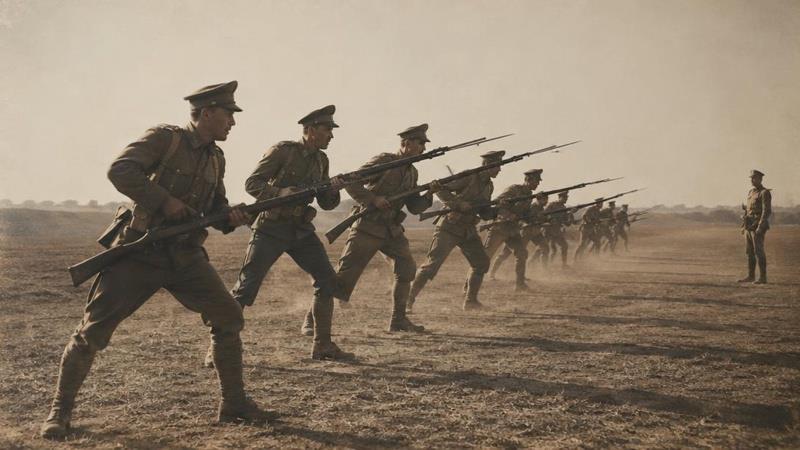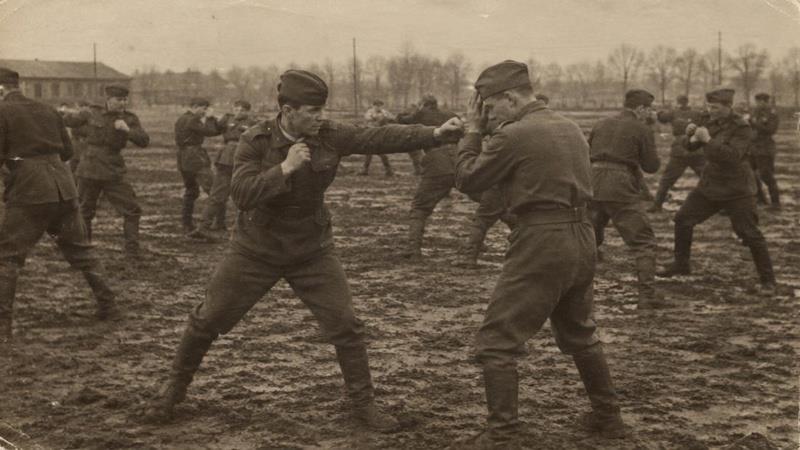
Defendu, Combat Judo and Wartime Manuals for Street Fighting. This article forms part of a short history of how the modern combatives curriculum has evolved. The main body of the text will continue to expand upon the original theme, incorporating history, training, safety and a civilian perspective. It is not a substitute for quality training or for advice on specific legal issues.
The original field note
This was the first widely taught military close-combat system and it was written to be a short syllabus that could be taught in weeks not years. The author was a British officer who was familiar with several Asian systems of fighting and had reduced them to a set of simple strikes, chokes and improvised weapons that could be taught to a conscript in a very short space of time.
Manualisation changed everything
As the techniques of fighting were written down in the illustrated field manual of a fighting system, a whole new world of possibilities was opened up. Suddenly the fighting system could be taught by thousands of instructors, never before meeting the originator of the system.
By “freely borrowing”, these wartime programs incorporated all sorts of techniques found in judo, in savate, in boxing. The author even borrowed a few knife techniques from the Filipinos. But, as we said before, a sharp editorial eye was kept on the whole lot of them. In the end only those techniques that could be easily described in a few words and even more easily learned from a drawing were included in the manual.
A technique that cannot survive a black and white illustration is probably too complicated for a battlefield.
The postwar correction
Many combat sports evolved from the physical training programs devised for soldiers in the decades following major conflicts. Although interest in these forms of hand-to-hand combat waned for many years, in recent decades they have experienced a revival amongst armed forces whose members are likely to find themselves fighting in urban environments and who are primarily equipped with guns.
Old military manuals are great reading material. The unsentimental and hard-nosed approach to training is inspiring and is largely absent from today’s marketing drives.
Training changes when missions change
A combatives syllabus for military use is a dynamic entity that is relevant for only a very short space of time. As the rest of a unit’s training develops, new skills and techniques are required and so too the methods for their implementation. A historian studying the various historical combatives used by the military would need to research in great detail why certain methods were kept and developed whilst others were discarded.
Use history without copying the battlefield
The lessons which can be derived from Military Hand-to-Hand Combat can be put into practice by the civilian. In fact, many of the lessons can be profitably derived from the study of past combative systems and their historical uses and development, without for a moment that the reader should even attempt to recreate any of the techniques in this article on himself in civilian life.
Read the record before the legend
Many historical accounts of combat sports come in the form of short films or even centuries-old paintings. However, by reading a few key dates, key changes in a mission, a single training manual, and the underlying problems that faced a certain unit, the reader will receive a vastly more complete account of events. In all cases, the reader will receive a more complete understanding of the various limitations (i.e. etc.) imposed by the particular time and place in which that unit’s history took place.
Start with context
I tried to look at this from a different perspective. The context for training in the military is so different from our civillian world and goals. I thought the best way to look at this would be to separate out the general training principles from the specific details as they pertain to the military and their various training programs.
What a responsible instructor looks for
At its core, a good instructor makes sure their students have a very clear notion of what they are trying to achieve with any given drill. They set boundaries and pay close attention to how students react under fatigue. They correct for unsafe speed, and ensure that new students are not placed in a situation where they are pressed to perform in ways that may cause harm to others. Most of all, they help their students understand the purpose of any given skill in the context of the entire program of training.
Keep the lesson practical
In addition to attempting to turn a historical subject into a useful and practical stepping stone for the reader’s training, the interested person can compare programs, improve his/her general fitness in order to prepare for more demanding classes, research the safety of various self-defense programs in his/her region, ask instructors about the manner in which they control intensity of training in live practice, and record what he/she actually learned from perusing historical accounts of methods.
Limits are part of the lesson
No article can replicate a qualified coach and good practice partners, special exercise equipment, and good correction given during the lesson. Every person has their own physical limitations and can have previous injuries that should be taken into account. Also, in many places there are laws that restrict some types of training. Therefore, written material should be treated only as an orientation. A responsible civilian should pick the most conservative version of the activity and go look for qualified instructors to learn from.
A reader’s checklist
- What is dependent on the military equipment, a team or a specific training area.
- Prioritize posture, awareness, fitness and safe decision-making over unknown techniques.
- How will the instructor control the intensity of practice and protect inexperienced learners?
- Don't carry on when the session is making you lame, confused or tired.
- Verify local laws and advice of relevant professionals before you are left with nothing but a general overview of the subject.
Closing perspective
“Roots of Modern Military Combatives” should foster disciplined inquiring, not imitating. The core of any military art in improving is repeating, reviewing and strictly applying standards. In the best way possible, that is how one can apply this article’s findings to training: verify a source; train only in an appropriate environment; keep an objective realistic. Measure progress by decisions taken while training for physical performance that improves as safer decisions are made.
Training note 1
Equipment should also be used with caution. A good pair of tracks is for example not made of expensive material but very flexible. The right protection for hands, legs and head, as well as comfortable sports clothes, are more important. The environment should be such that the student is able to train safely.
Training note 2
Progress is rarely linear. Some training sessions will improve your timing whilst others will show up fundamental weaknesses that you may not have been aware of. It is only by discovering these weaknesses in training, in a controlled environment, that you can then work on improving them before ramping up the intensity of your training.
Training note 3
Keeping track of your progress in a journal has several advantages. First, the journal will help you to structure your training sessions in a proper way. Second, you can find out in a very efficient way which change helped in the learning process. Third, you will have the chance to talk to your instructors about your progress. This is much better than relying on your memory after a very tough session.
Training note 4
Equipment, like outfits and extras for practices, is to be used with restraint. Consuming, high quality equipment like good athletic apparel, a safe gym floor and right protective gear for practices is far more important than flashy, high-priced extras to aid in lessons.