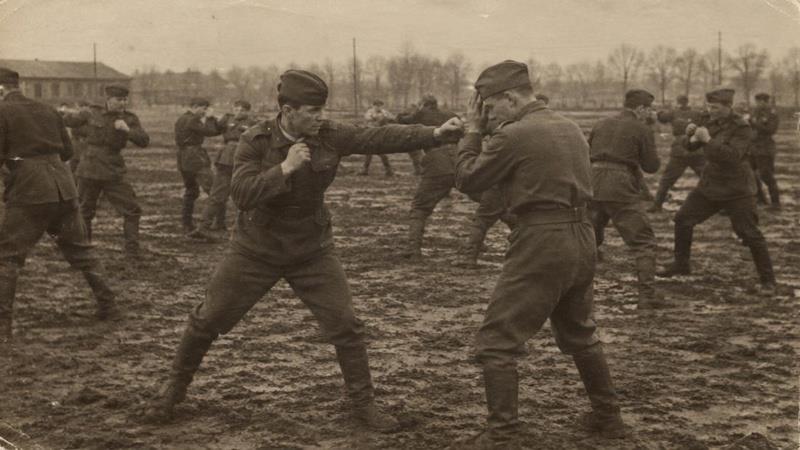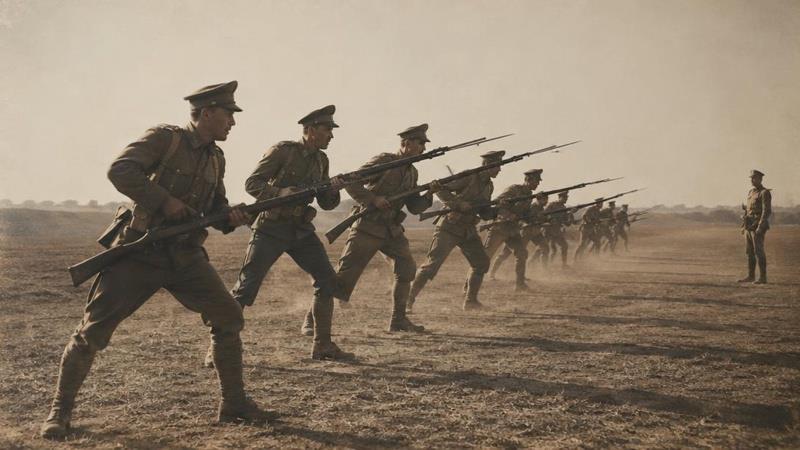
So we covered a great summary point of obsolete military tactics (that still have lots of value for teaching other physical skills) that help build of aggression and of coordination in order to teach other physical skills, like becoming deadly with weapons. This summary was great, but lots more could be written on the specific subject of the Bayonet Charge drill. That’s what the following discussion aims to cover in more depth and include in more history and in more detail about how training would actually occur as well as safety, etc. with a civilian perspective.
The original field note
The bayonet drill is a very old method of military combatives and thus often remembered with a certain degree of nostalgia. However, none of the several methods of attacking with the bayket ever really were intended for fencing. The true intention was always to bring a line of aggressive soldiers forward in a charged situation.
The mechanics of the drill
The drill utilized a very small number of movements, including a thrust, a parry and a butt stroke. Importantly though, when practiced in groups, within the confines of a drill, the order to execute a series of movements, one after another in turn, would, without the participant thinking about it, cause a line of individuals to execute a series of movements at the same time.
The bayonet drill was NOT intended to teach the soldier how to be deadly with a bayonet. What it was intended to do was to teach a line of 100 very frightened soldiers to advance as one animal.
Why it survived into modern training
Even after the combat value of the bayonet was largely cancelled, the drill continued to be used in recruit training for decades. It gave the soldiers a physical outlet for their pent up energy, helped them to develop their fighting skills, promoted coordination and, above all, generated an atmosphere of shared soldiery.
For decades, the likeable old bayonet drill formed the climax of recruit training, providing a physical outlet for aggression, and enabling a hundred people to develop a shared way of doing things within the space of an afternoon. After that, the physical contact element of military training was transferred to the appropriate part of the modern syllabus for combatives.
Use history without copying the battlefield
Even within a strictly military history context, the lessons one can glean from such scenarios are vast. But if one is a civilian, without a deployment imminent, one can focus on learning skills similar to those practiced by our soldiers: preparation for unknown scenarios, increase of physical confidence in face of adversary, lessons in effective teamwork, growth through very disciplined practice, and gaining insight into the intense stress of a fight. At all times one must be very clear, however, as to how the rules of engagement (or ROE), for example, the kind of arms and equipment they have at their disposal, and the many legal constraints on the soldiers, are utterly and completely different from one’s own own life experiences.
Read the record before the legend
Most military history is told through the enthusiastic retelling of battles, legendary units, or overwrought documentaries. When we read military history for training we must, of course, start with dates, changes in a unit’s mission, training manuals, and the problems with which said unit was equipped to deal. The ensuing history will doubtless remain dramatic enough, as we discover the limitations of a particular time and place, in addition to the tools and the hierarchy that the fighting man had at his disposal.
Training changes when missions change
When a unit changes its mission, the combat tactics and scenarios too will change in the combat techniques’ lessons, as well as in the communication, first aid and armament techniques. A syllabus of combative techniques is not something to be put in a museum shelf. Relevant historical questions about hand-to-hand combat systems are not about which of them was the best in abstract terms, but rather why a given system managed to survive in practice.
Start with context
The title of an article doesn’t have to lock you down to the whole article, especially when the article itself is about military training. So in this case we are speaking of military training for military purposes (mission, physical equipment, team support and chain of command) and thus quite distinct from your own personal training for your own purposes. So we can have a look at the article as a whole and split off the universally applicable parts from the parts that are specific to the unit in question and to date.
What a responsible instructor looks for
This type of training looks to have a very clear purpose and structure. The teacher is on hand to correct you and point out errors such as unsafe speed of movement. As with all training a new student to a skill is looked after and treated with respect and not pushed beyond what is safe for their development. It is also essential to find out how what you are learning is going to be used in later drills and training sessions.
Keep the lesson practical
In this article on military history and hand-to-hand combat, the combat techniques themselves will not be demonstrated. Rather, the article will be used as inspiration for civilian readers to explore programs and facilities that teach the same subject. Such readers can look for reputable programs, get in shape, search for local safety resources, and ask an instructor how he or she controls live practice for beginners. All of this can be learned with small, verifiable steps.
Limits are part of the lesson
No article can, however, contain any coaching (although we will cover all forms of combat training). A suitable partner is also out of reach as is any protective equipment that can be used in a training setting. Be also aware that in many cases individual health and previous injuries can render certain parts of a lesson unsuitable as well as local law. So treat any general information contained within an article as nothing more than good orientational material and go for the most conservative approach possible and seek out good quality instruction where you can train in live practice within a suitable controlled training environment.
A reader’s checklist
- Identify which parts of the lesson depend on special military equipment, a team of trainees or a controlled training area.
- Focus on good posture, awareness, general fitness and making good decisions rather than random techniques.
- What measures will the instructor use to control the level of physical stress for you, a total beginner to training with swords?
- Stop the activity if it causes pain, if you become confused or if you become fatigued.
- Verify local laws and regulations in relation to advice given.
Closing perspective
“Bayonet Drill and the Discipline of the Line” serves the purpose of helping readers learn more about the discipline of the Line in a meaningful way and they apply the same processes used by military programs for improvement (i.e. repetition, review, etc.) in finding the right sources for learning activities to practice in appropriate settings with realistic objectives in order to gauge progress by means of safe decisions in addition to physical ability.
Training note 1
It is rare for improvement to be linear. Some training sessions focus on improving your timing for a technique, others highlight a weakness in your current base, and others expose poor decisions that you are making. Identifying these issues within controlled practice allows you to focus on solving specific problems before increasing the intensity of your training.
Training note 2
Use your training journal to log the session details and how the different parts of the session developed. The most valuable session details are the session objectives, the conditions that applied prior to the session and how they changed, and what correction had the greatest impact on your performance.
Training note 3
So too with the equipment used to teach a new skill. It should not be unnecessary to hinder practice. In Fencing we use shirts made of material that will not get in the way of our blades. We have smooth surfaces on which to practice our footwork and protective gear to stave off serious injury. That is all the equipment you need.
Training note 4
Most sessions will improve a couple of things but reveal some underlying defects too. The work done in practice session will reveal some specific problem that the student and teacher can then go and work on before increasing the intensity of training.