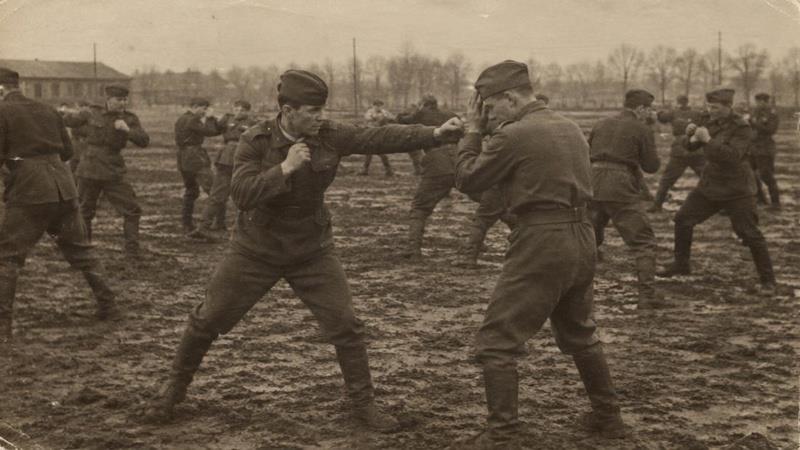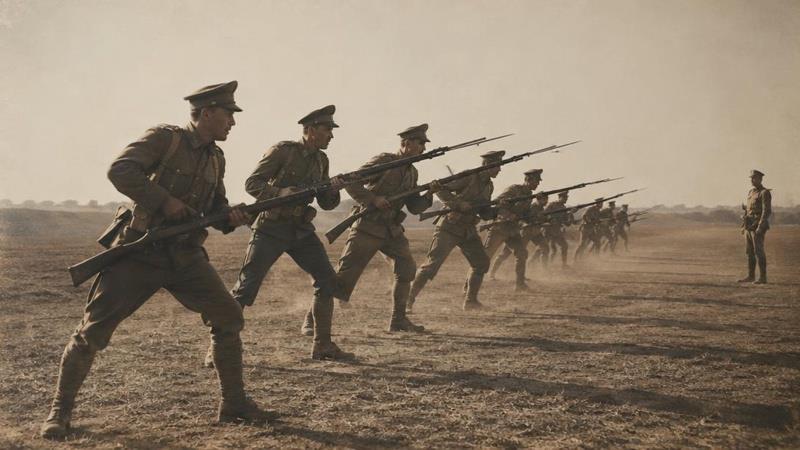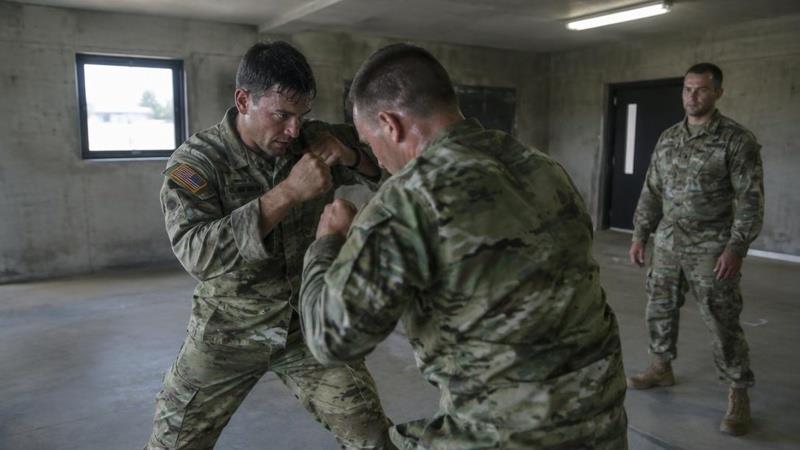
As mentioned previously, the Army combatives curriculum does not include a lot of flash in the training. Instead, the curriculum is designed to be able to be repeated over and over again. This article will outline the framework of a typical combatives class, including the clinch, takedowns, ground control, and transition back to standing. This is a very detailed subject and in order to do it justice, the article will delve deeper into the history of the training, as well as go into the context in which the training is done, as well as safety considerations. As always, this is not a substitute for actual training with a qualified instructor, nor does it guarantee to impart knowledge on how to defend yourself legally.
The original field note
A quick quiz for a combatives instructor, ask them to list off the core techniques for a combat training program, they’ll list off a sequence of movements that start with closing the distance to take control of an opponent and end with returning to your feet and to your weapon.
1. The clinch is the foundation
At the heart of the ground work lies the clinch position – students learn to form a collar tie with one arm and use the other to form an inside bicep control on their opponent, all the time keeping their hips square to their opponent and avoiding a reach with extended arms.
2. The takedown is a decision, not a goal
Mandatory military takedowns can be simply be described as double leg takedowns entered low, body locks or trips from the clinch. You want to know where you land, for example a Bad landing in an odd position is far worse than a good defensive posture on your hands and knees.
3. Ground control, then escape
Ground work is taught to escape positions first: how to get out of side control, how to get out of mount, how to establish a base and get up to stand. Offense is also taught but after the student can complete the above objectives.
The army does not teach you to win on the ground. It teaches you to survive the ground long enough to stand back up.
Some basic training drills to increase ability under fatigue would be to drill these three blocks of a combatives lesson for a few months, 2 times a week. This will increase a soldier’s usable ability in combat much more than collecting lots of different techniques for a year.
Practice should be measurable
If your practices have a purpose – be it to remain centered while your partner moves, to recover your posture, to recognize when the distance to your partner has changed, or to communicate clearly when a drill comes to an end – then these goals can be measured, even while you reduce the intensity of your work as fatigue begins to impact your technique and your judgment.
The civilian objective is disengagement
Military combatives are designed to fight in the context of a mission with the support of other team members. Thus, civilian self-protection has very different boundaries. Training must therefore always be framed within the constraints of local laws and be aimed at creating space and withdrawal to safety and contacting the relevant authorities as soon as possible.
Simple movement survives pressure
Fundamental techniques can be drilled in repetition at slow to moderate tempo. Learning to maintain a good balance, safe posture of head, and stable base of support, while at the same time developing the ability to safely exit from any given situation, is far more important than mastering a vast array of complex and frankly fanciful techniques.
Start with context
The title of this article does not refer to a technique to practice, but rather to an area much larger than that of a single martial art technique. Military training refers to a series of practices to achieve a specific goal in the context of a specific mission, using a specific equipment, in support of other soldiers within a chain of command. How useful is it for a civilian reader to read an article about military training for ground fighting?
What a responsible instructor looks for
The instructor, is clearly outlining the intent of the drill, setting boundaries for the student, and observing how the student handles fatigue. They are correcting the student for performing the drill too fast, safeguarding the interests of new students, and giving the student a sense of how this skill fits into the rest of their training. The student should gain confidence in a safe and structured learning environment and not under cover of secrets, humiliation or hype that promises instant results from a single weekend.
Keep the lesson practical
Rather, the article can be read as having given the reader useful information regarding how to go about training in self-defense. He or she can now look for quality programs and training, get in better shape, research local resources to deal with safety issues, ask an instructor how live training is done, etc. Remember, even the best article can only give the reader so much information regarding effective training in self-defense, and that is best done one step at a time.
Limits are part of the lesson
Unfortunately, a single article can’t replicate coaching a student, a suitable training partner for them, the relevant protective training equipment and most importantly immediate correction to any mistake they are doing while training. Each person has their own unique health constraints, previous injuries that affect them and laws governing self-defense in their place of residence. All training should be viewed as orientative in nature. As such the prudent individual will seek out qualified instructors for all training that could have serious negative consequences for themselves or others should they fail.
A reader’s checklist
- Identify specific parts of the lesson which are dependent upon specialized military equipment, a team of trainees or a specific and controlled training area.
- Instead of practicing unknown techniques, train the basic components of a combative situation such as posture, situational awareness, physical fitness and making good decisions under stress.
- Ask the instructor(s) how he/she will control the intensity of the training and protect the beginner.
- Stop practicing when you get pain, confusion or even just fatigue and continue practicing when you’re safely back to being able to move in a safe and smart way.
- Check local law and professional guidance before treating general information as a plan.
Closing perspective
“Core Army Hand-to-Hand Combat Techniques” is best read by others as a means to stimulate disciplined curiosity and assist in structured training within a military setting. Repetition, Review and Standards are the core of military programs. Core Army Hand-to-Hand Combat Techniques can be best applied by verifying a source, training within appropriate means and with realistic goals and measuring improvement by means of safe decision making in addition to physical abilities.
Training note 1
Your equipment needs the same respect as your body. You don’t need to spend loads of money on fancy clothing. A safe surface to train on, suitable protective equipment and some comfortable clothing is all you need. Don’t let your environment create new hazards that you can then expect to avoid in other situations.
Training note 2
Training in various sessions is rarely linear. We work on a student’s timing in one session and find out in another that his/her basic skills are not where they should be. Often a student makes a decision too late. Finding out about these problems in a controlled environment is valuable to both student and instructor and something that can be addressed as soon as possible before the intensity of the training is increased.
Training note 3
Having a training journal can be really helpful for recording: What you were trying to achieve with the session, The changing circumstances, And how one small change had a big effect.