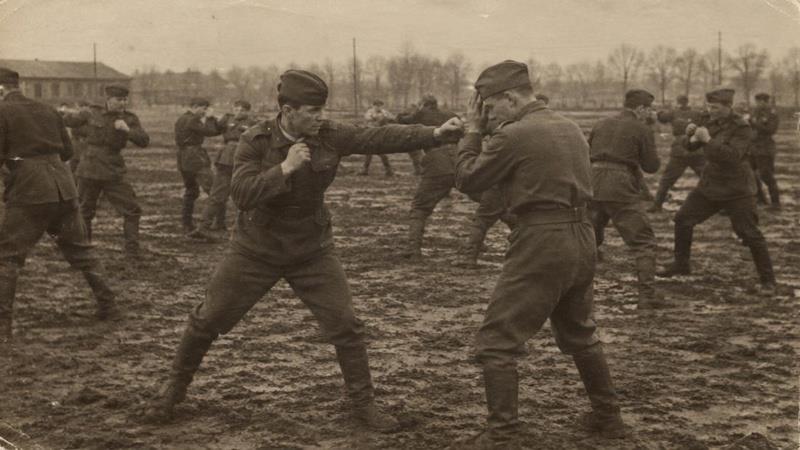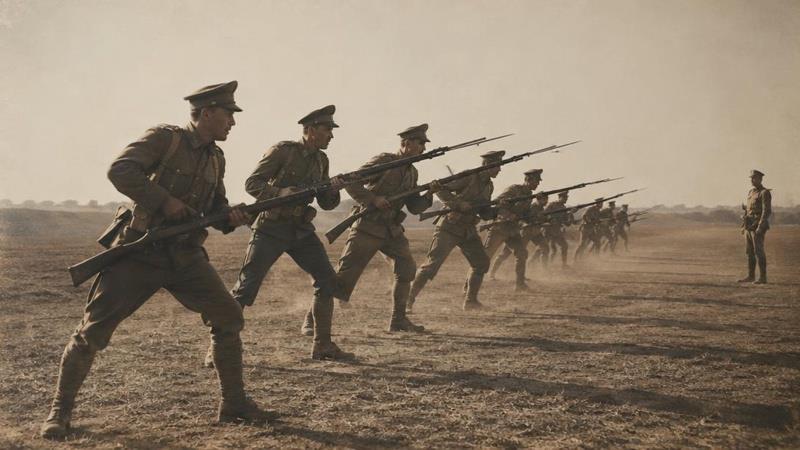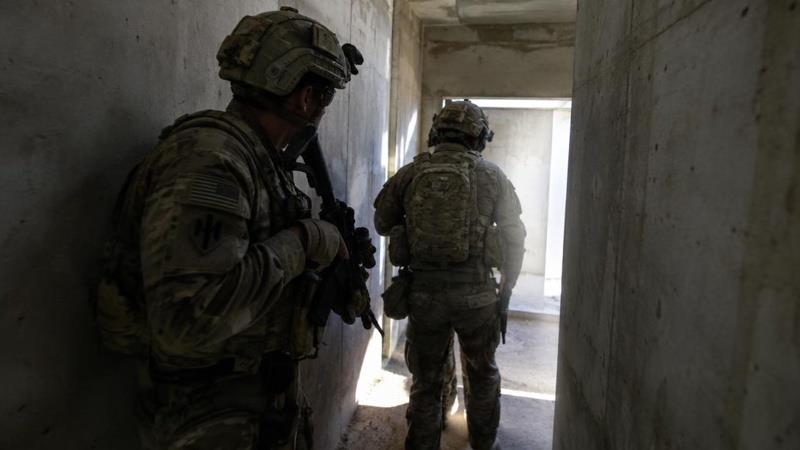
These articles describe military close-quarters combat skills, how they are trained and some historical background. Note that the skills and training methods described here are not to be practiced without proper supervision and in accordance with local laws. There is also a summary at the end to give a brief overview of what close-quarters combat skills consist of.
The original field note
Close quarters combat is one of the less glamorous aspects of a soldier’s training. It is also the most rehearsed – a series of minor corrections that are repeated to the point where they become second nature and cease to become a decision that you take.
Footwork before force
The student starts practicing footwork within the first weeks of training. Where to place the lead foot when walking forward, how to enter a room, how to retreat from a room are all common mistakes in close quarter situations that can be easily avoided.
Next, students practice different ways to use the footwork to control their opponent's body. This includes trapping an opponent's limb between two walls, using the corridor of a room to restrict an opponent's movement and creating a 'lane' for an opponent to travel in.
Corridors decide fights. The person who understands the space usually wins before the first strike lands.
Being corrected in public
Public training is part of a soldier's training. All mistakes are openly pointed out in front of the group. This helps to prepare the soldier for the day when he is going to be in a real situation where he could die, and where he will have to act very fast. He has to get used to not being embarrassed in public.
For a civilian, this translates to finding a coach or instructor who will deliver the exact same message: “You did that badly” and then give you the chance to correct it under controlled circumstances.
Simple movement survives pressure
Rather than teaching lots of complex movements which the student will never use in a fight under stress, military instruction focuses on teaching a few simple movements that can be repeated over and over at slow speed with full attention, under the watchful eye of a good instructor, using appropriate protective equipment and with a clear and obvious stop signal as required.
Practice should be measurable
Measurable objectives for training include ability to stay balanced while another person moves you in different ways, recovery to good posture after falling, ability to recognize when you have moved closer to an opponent, and clear communication with your training partner to bring an end to a drill.
The civilian objective is disengagement
In contrast, the goal of military combatives is to successfully complete a mission. The practice of civilian self-protection is restricted by local laws and seeks to create space between the student and their attacker to allow for safe retreat and contact with appropriate authorities. This end must be the aim of all effective practice and training.
Start with context
The title of this article is a link to a much longer and more detailed article on the subject of military training for hand-to-hand combat, and the differences between that sort of training and that needed by a civilian for self-protection. Most of what is covered in that article is of little use to a civilian, even of general interest. The most useful thing to read is the introduction to the article, which outlines the key factors that shape the training of a combat soldier, and so gives the reader a sense of the limits of applicability of the rest of the article.
What a responsible instructor looks for
They make sure you know what you are doing in a drill and set boundaries for your training. They observe you when you are tired and correct you when you are traveling too fast. Your safety is of the utmost importance as well as that of your fellow students. New students must be treated with care and not put under too much pressure.
Keep the lesson practical
Rather than attempting to recreate footage of potentially deadly fighting in the home, the interested reader could look into comparing various self protection programs and fitness training, research local resources for safety and review, contact various schools and find out how a live practice is controlled, and more importantly, take good notes on what you learn in a variety of training sessions.
Limits are part of the lesson
Articles cannot teach classes, reproduce coaching, safe partners, safety equipment or immediate corrections. Every person has different health, previous injuries, learning style and local laws to abide by. Therefore the article is only meant to be used as an orientation to close quarters combat (CQC) training. Always err on the side of caution and seek out qualified instructors for your training.
A reader’s checklist
- Identify which parts of the lesson depend on military equipment, a team or a controlled training area.
- Focus on good posture, awareness, general fitness, and making safe decisions rather than a list of untested techniques to practice.
- Ask how an instructor will control intensity for a beginner.
- Stop when pain, confusion or fatigue makes movement unsafe.
- Verify what local laws and regulations need to be adhered to in relation to the information outlined in this article.
Closing perspective
“Close-Quarters Combat Skills” offers a useful perspective for anyone to build skills in a military program – disciplined curiosity. Programs are developed and improved through repetition, review and adherence to strict standards. Apply that same sense of discipline when seeking to develop skills in a civilian program: verify information from quality sources, practice in appropriate conditions, keep objectives realistic, and gauge improvement through ability to make safer and smarter decisions as much as physical skill.
Training note 1
Many martial arts schools have their students record in a training journal the purpose of their session, the conditions that have changed since their last session and what correction helped most. This allows for much better discussion of progress with the teacher than simply relying on memory of a long and arduous training session.
Training note 2
Remember that when choosing equipment for a class, focus on the basics. The student does not need expensive accessories. Provide them with comfortable clothing, a safe surface to practice on and protective gear when needed. Ensure that the learning environment will not cause harm to the student.
Training note 3
There is rarely instant improvement in areas such as your timing and it may take a number of sessions to highlight a deficiency in your basic skills or how you decide to make a decision. However, in practicing these areas in a controlled environment you will be able to work on these problems before practicing at a higher intensity.
Training note 4
A training journal is used to write down what you have learned from a session, including the purpose of the session, what changed from previous sessions, and what correction had the most impact on your training. This will enable you to better discuss your progress with your instructor instead of relying on your memory of a very demanding session.