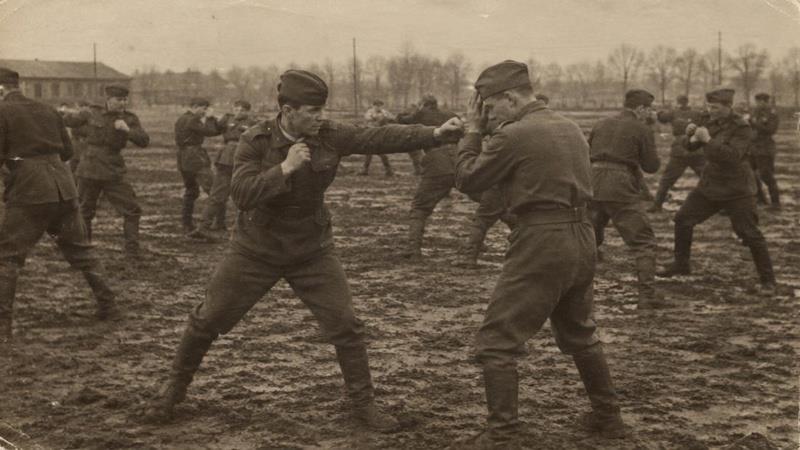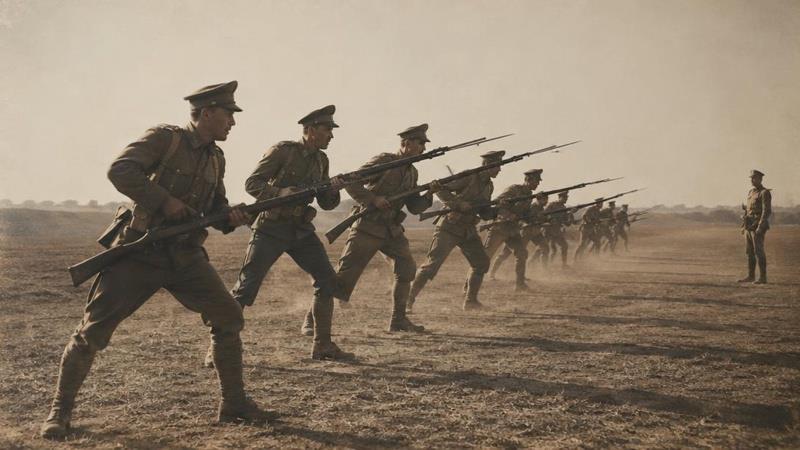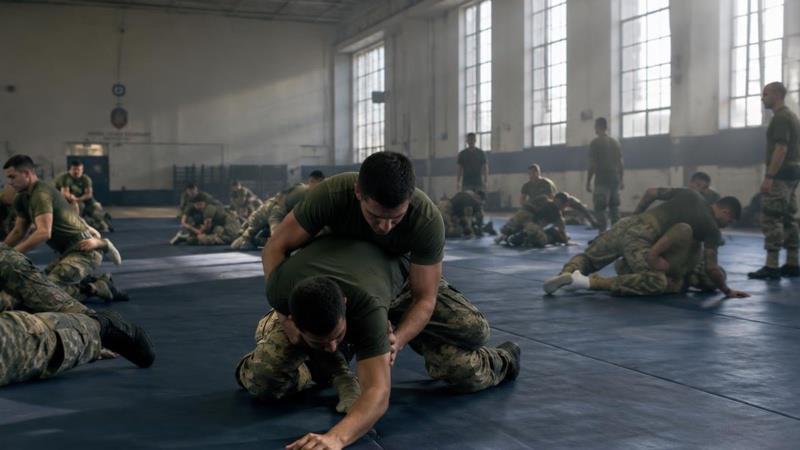
While we attempted to cover all of the necessary ground in the summary above, there is far more to explore of the same theme. In the body of this article we will outline the full history of military martial arts training, as well as a breakdown of the specific training, including the circuits, partner drills and pressure testing, that makes up the full Martial Arts program for a recruit. This will be written with full training context, as well as safety considerations for both the instructor and the student, and will serve as the educational material it was intended to be, rather than a means to instruct in itself or to provide legal counsel.
The original field note
Of course the entire martial arts program of the military is designed by people who don’t have years to spend with their troops. A soldier usually gets to do forty hours of combatives before he gets shipped out to fight. Those forty hours have to count.
Blocked practice, then random practice
After a technique has been worked in a series of blocks the entire block is replaced by random practice. This means that in each round of practice the student is called upon to react to a different type of attack rather than repeating the same entry over and again.
Moving to random practice soon after also testing students in making decisions is a hallmark of a good martial arts program and is far more important than a list of techniques in classes, which most civilian schools fail to deliver.
Repetition builds the tool. Random practice builds the person who can pick the tool.
Fatigue as a teaching tool
Note that classes can end with practitioners performing the same technique whilst fatigued, for example after having completed a long run, or after having been involved in preceding physical activities, such as long marches with heavy packs, or doing hundreds of press-ups. The fact that the technique has been learned does not necessarily mean that you have learned how to apply it!
Train one technique to exhaustion every week for much more insight into its properties than you would acquire in a month of comfortable repeats.
Conditioning supports skill
The various aspects of physical conditioning – mobility, aerobic capacity, grip strength and recovery – are crucial to whether a person is able to maintain their technique in training. Effort should gradually increase and trainees should be able to recognize the point of productive fatigue as against being in pain and worsening their situation. Prioritable sleep and recovery between sessions is also crucial to maximizing learning in training.
Systems are tools, not identities
Most classes in Boxing, Wrestling and Martial Arts focus on learning a Style, some Techniques and do lots of silly movements. Military Conditioning Programs, on the other hand, look to put together the very best systems and techniques that have been proven to work in actual combat situations. Civilian students of any martial art can greatly benefit from realizing that there is no single style that can solve all their problems. Even more importantly, any good martial art program will focus intensely on the study of fundamentals of any technique and the rules of whatever particular “game” they are playing.
Good partners make good practice
Someone can give you great resistance in practice, help you learn techniques and improve your fitness, communicate with you, add more weight or reps to your practice as you get better, and make sure you are OK if you get hurt badly. Help you learn. Protect you from harm.
Start with context
Note that the title of this article refers to a much larger subject matter than what you will read between these lines. Military training is a mission orientated activity which are conducted using the resources available at the time to achieve a specific end within a framework of a chain of command and in support of a team. For the purposes of civilian training therefore, much of what is written will have to be applied on a broader basis.
What a responsible instructor looks for
Reputable instructors are clear with the aims of a drill, specify limits within a practice and can test a student under fatigue. They spot and correct for unsafe speed of execution of techniques and protect the novice from the more advanced practitioner. As the student learns more techniques, the instructor will explain how they are utilized within his/her overall training structure.
Keep the lesson practical
In understanding the value of any martial arts training program, one does not have to try all of the various forms of practice. Rather, a smart reader can read about different training programs, enhance his/her general fitness level, research safe training resources, ask for references from different instructors and schools and note what one learned from any one training session. One does not have to imitate some dramatic pose in a still photo from a clip.
Limits are part of the lesson
Again, no article can ever hope to fully and properly replicate the actions of a very good martial arts coach, and, therefore, MUST be approached and viewed with great respect by students, who MUST exercise their best and highest judgment in exercising wisely the information contained within this Internet article. In short, learn from it, but be very wise and cautious, in all cases!
A reader’s checklist
- Identify which sections of the lessons require the use of military equipment, a team, and a martial arts training area.
- Instead of adopting the techniques and drills of all the past and present military martial arts look to the training methods and practices to aid in your progression to a more discerning martial artist.
- How would an instructor control intensity of a workout (and therefore a drill) and protect newer students of martial arts?
- Stop when you are tired, in pain or confused. Move to a safe position and treat injuries with respect.
- Check local law and professional guidance before treating general information as a plan.
Closing perspective
“Training Methods in Military Martial Arts” can be very useful for civilians practicing martial arts, in so far as it awakens disciplined curiosity. Training in military martial arts programs involves repetition, review of earlier lessons, and setting of high standards. This is also what the practitioner of civilian martial arts should do: verify the source of a training method; practice in suitable environment; keep a realistic goal; measure improvement in terms of safer and more efficient decision-making as much as in development of physical skills.
Training note 1
The progress of most students goes in fits and starts and so a session may improve their timing whereas another session will expose a weakness in their basic technique or a poor decision. Identifying these issues within a controlled practice session is extremely valuable and something that both the student and instructor can work with before increasing the intensity of their training.
Training note 2
A good training journal has four columns: What am I doing? What conditions are there? What did I do? What worked?
Training note 3
Apparel, surfaces, etc. must be approached with the same caution as other methods to train with. The best training tools are comfortable, adequate, protective, etc. Training equipment is meant to facilitate training, not pose the chance of injury that the student then has to ‘mirror’ in their own training.
Training note 4
As every student knows, training doesn’t always go as planned. Some sessions improve your timing whilst others can expose underlying weaknesses and mistakes that you’ve been making. It’s all good though as you can address these issues in a controlled practice before increasing the intensity.